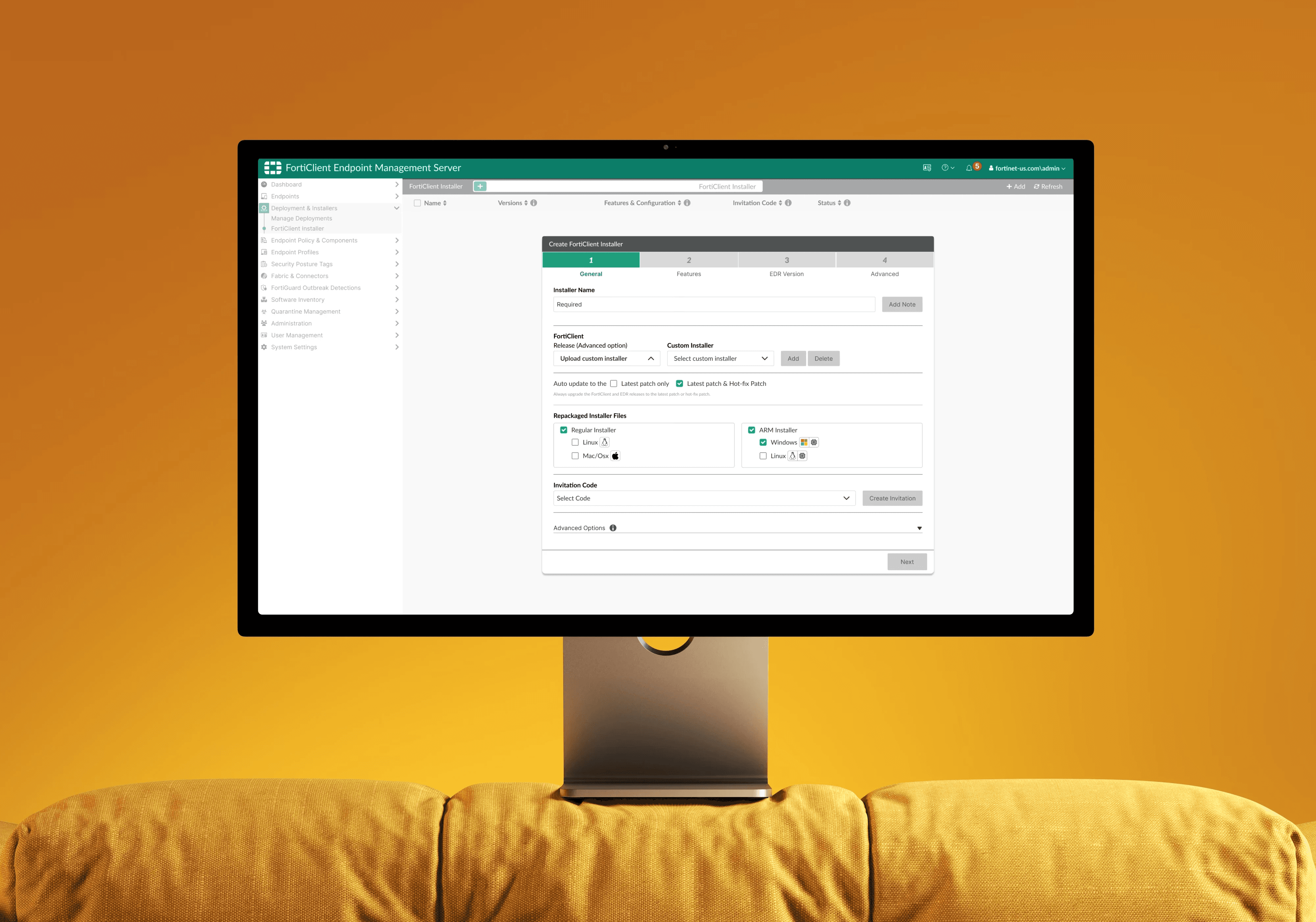
FortiClient Installer

Transforming event remediation from 24+ hours to under 10 minutes.

In 2024, Fortinet introduced a new Event Management feature within the FortiClient Endpoint Management Server (EMS), designed to give IT administrators real-time visibility into endpoint events and the resources to act on them instantly.

As Lead UX Designer, I owned the initiative end-to-end — defining the vision, consolidating fragmented workflows, uncovering usability gaps, and aligning cross-functional teams from concept to implementation handoff.

Through deep user research, I identified a critical gap between event visibility and remediation and designed a workflow that bridged it seamlessly. The result was a faster, more intuitive response experience that saved IT administrators over 23 hours per remediation and delivered more than $100K in annual time savings.

Product

Web design

Skills

User research & testing

Painpoint discovery

Stakeholder management

Product design

Interactive prototyping

Public speaking

Role

Lead designer

Team

Kunal Marwah, Thiago Santana, Tony Huang, Kelvin Tao

Timeline

March - August 2024

Business Goals

FortiClient is an endpoint security platform with over ten features, including VPN. IT admins use its management console (EMS) to monitor and secure corporate devices.

The project’s initial goal seemed simple: combine all endpoint events into one view. Technical leads assumed that centralization and better visuals would improve the experience.

User research revealed the real issue — admins could see events but couldn’t act on them. Without a clear path from event → remediation, the feature was just another reporting tool

Discovery

This was one of the most challenging projects I led at Fortinet not for its design complexity, but for the resistance it met.

User research revealed that IT administrators found the existing EMS events feature nearly useless. The reason was simple yet critical: it didn’t show the exact file path for detected events.

Without that detail, admins were forced into a painful workaround asking end users to open their FortiClient console, capture screenshots, and send them back. Each request could take hours or even days, depending on user response times.

At scale, the impact was massive. An admin managing 10,000+ endpoints could spend entire days chasing screenshots instead of resolving threats. EMS offered visibility, but not the information needed for action.

When I presented these findings, reactions were mixed. Stakeholders felt consolidating events into one view was enough. Challenging that assumption and proving why it wasn’t required patience, evidence, and reframing the problem around lost time, inefficiency, and business risk.
Results

Designing for power users demands more than clean interfaces it requires deep understanding of workflows, edge cases, and business realities.

For IT administrators managing thousands of endpoints, the stakes were high. They needed instant visibility into threat details and seamless paths to remediation.

The challenge was getting stakeholders on board. Bridging event visibility with remediation meant redefining the project’s original scope, but it was the only path aligned with Fortinet’s mission to keep admins secure, informed, and empowered.

I reframed user pain points as business metrics lost hours, higher costs, and low adoption. This shift turned opinion debates into data-driven alignment, securing buy-in to design a complete event-to-remediation workflow.

User Centred Solution

The final design delivered a suite of enhancements that transformed how IT administrators viewed and resolved threats.

Admins could now see the full file path directly from the event table, eliminating the need to request screenshots or rely on end users for critical details. Each event entry linked seamlessly to guided remediation workflows, enabling admins to investigate, validate, and act all within EMS.

This closed the gap between visibility and action, turning event monitoring into a powerful, end-to-end remediation experience.

⭐️

Connect to Content

Add layers or components to make infinite auto-playing slideshows.

The final design delivered a suite of enhancements that transformed how IT administrators viewed and resolved threats.

This closed the gap between visibility and action, turning event monitoring into a powerful, end-to-end remediation experience.

The final design delivered a suite of enhancements that transformed how IT administrators viewed and resolved threats.

This closed the gap between visibility and action, turning event monitoring into a powerful, end-to-end remediation experience.

The final design delivered a suite of enhancements that transformed how IT administrators viewed and resolved threats.

This closed the gap between visibility and action, turning event monitoring into a powerful, end-to-end remediation experience.

Avoiding Redundancy

With alignment secured across users, technical leads, and executives, I translated the new direction into an interactive Figma prototype that captured the exact experience IT admins needed.

This wasn’t just a design deliverable — it became a shared vision. The prototype served as a bridge between design, engineering, and product, enabling everyone to see, click, and understand the full remediation flow before a single line of code was written.

Through multiple feedback rounds with real admins, we validated key usability improvements and confirmed the solution addressed every core pain point identified in research. What began as a controversial project evolved into a collaborative success, uniting teams around a clear, user-centered direction.

Validated Impact

By bridging the gap between data and action, the feature enabled IT teams to resolve incidents faster and with greater confidence. What was once a multi-day, fragmented process became a seamless, end-to-end experience cutting remediation time by 23+ hours per case and saving Fortinet IT organizations over $100K annually in productivity and support costs.

Next Steps

By bridging the gap between data and action, the feature enabled IT teams to resolve incidents faster and with greater confidence. What was once a multi-day, fragmented process became a seamless, end-to-end experience cutting remediation time by 23+ hours per case and saving Fortinet IT organizations over $100K annually in productivity and support costs.

Case Study

Still curious about this project?

Request a case study demo.

Next Project

By bridging the gap between data and action, the feature enabled IT teams to resolve incidents faster and with greater confidence. What was once a multi-day, fragmented process became a seamless, end-to-end experience cutting remediation time by 23+ hours per case and saving Fortinet IT organizations over $100K annually in productivity and support costs.

Let's discuss how I can drive measurable UX impact at scale.

2026 VICTOR ISICHEI

LinkedIn

LinkedIn

LinkedIn

LinkedIn